
LEIGH ANN WILLIAMS HICKEY
Leigh Ann Williams Hickey is a working artist and educator who resides in Fort Worth, Texas with her husband and two dogs. She received a BFA in printmaking from Texas Christian University in 1993, and an MFA in painting from Texas Woman’s University in 2010. She was an art educator from 1998 to 2019. Her teaching accomplishments include being a Fulbright Hays Scholarship winner and she was Associate Professor of Graphic Design and Gallery Curator at The Art Institute of Fort Worth. She is currently a full-time docent at the Modern Art Museum of Fort Worth. Leigh Ann has been a part of numerous juried and group exhibitions throughout the United States. She enjoys traveling and experiencing other cultures around the world.
Artist Statement
Empty Nest Syndrome is a body of mixed media paintings and assemblage sculptures that transforms the personal history of reproductive loss into a shared language of maternal longing, abandoned time, and the body as archive.
The work emerged from EMDR therapy undertaken after I experienced bilateral frozen shoulders that left me homebound for nearly three years. That period of enforced stillness became the container in which decades of grief were finally examined: abandonment by a biological father, an abortion in my early twenties, three rounds of failed IVF, a miscarriage, and the accumulated weight of being told, repeatedly, that I could not fully understand something because I was not a mother.
The work begins from a deceptively intimate starting point: the paper wasp nest. The nest are communities once thriving and full of families but now empty and abandoned. The paintings are on wood panels and painted at a ratio of one inch to one foot. A nest you'd cup in your hand becomes a confrontation. The substrate is not incidental: paper wasps eat wood to build their nests, so the work is made on the very material from which its subject is constructed. This kind of material logic, where medium and meaning are inseparable and runs through every element of the series.
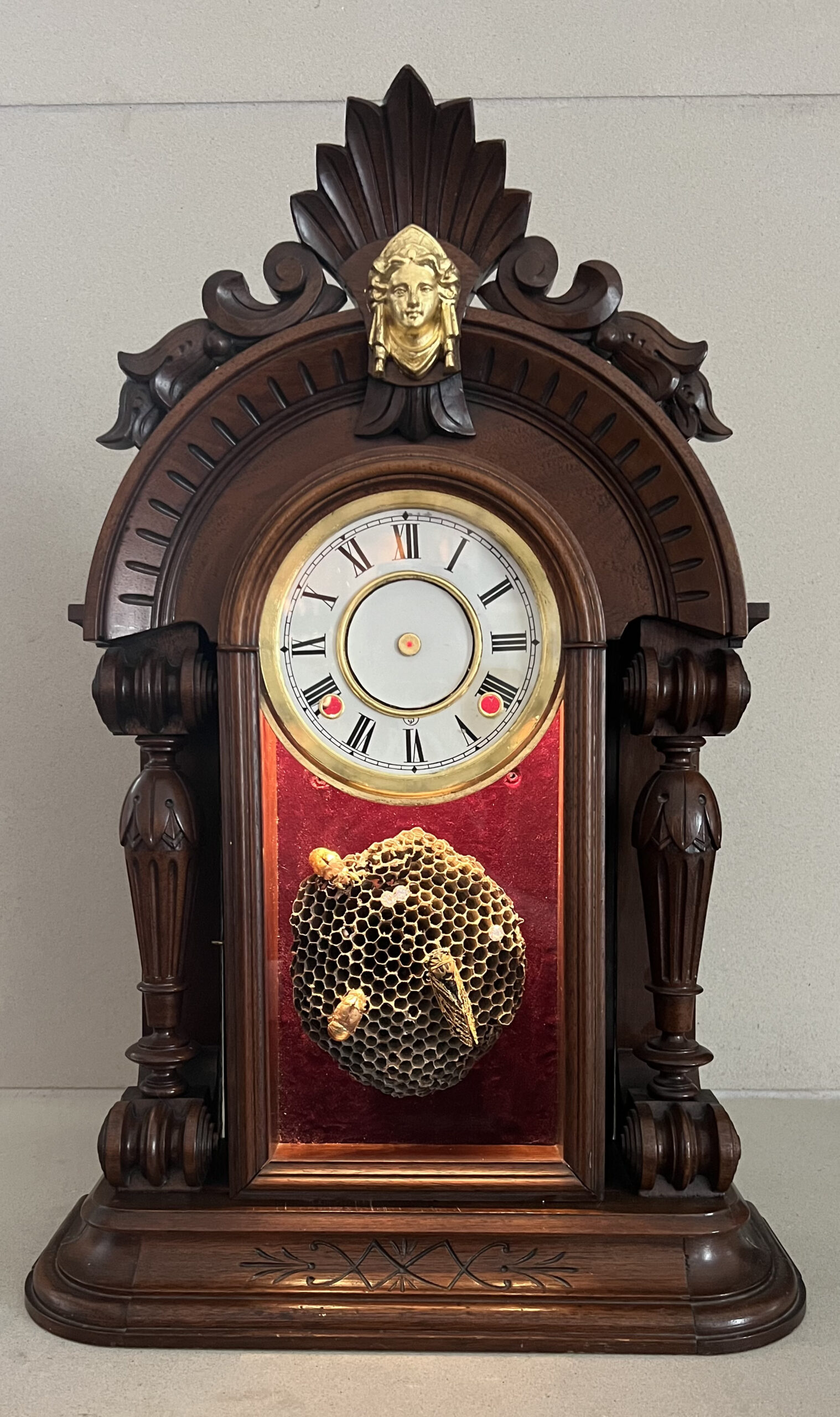
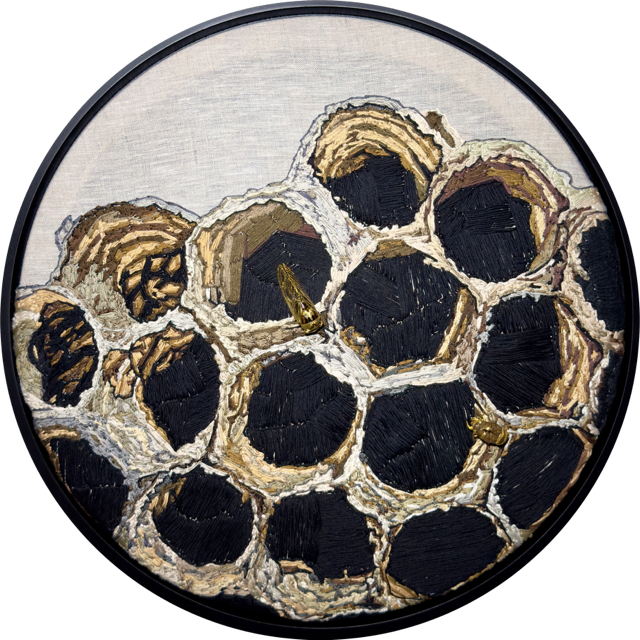
The assemblage’s layer in inherited clocks (bequeathed from an estranged biological father, built by his father), teacups I would have given a daughter who was never born, and lab-grown stones that echo the clinical vocabulary of IVF. Cicadas which represent my choices are gilded in 23-karat gold and reinforced with resin until they read as reliquary objects. Embroidery appears as a form of labor: repetitive, interior, building from the inside out. Each element carries specific weight. Nothing is decorative.
The work is autobiographical in its origins and communal in its resonance. Every woman who has been in a fertility clinic, who has made a complicated decision about her body, who has carried a grief that has no publicly recognized name, is present in these objects. Original nests are often displayed alongside their painted counterparts, collapsing the distance between source and subject.
These paintings and sculptures express my feelings of being ostracized by my personal choices.
LEIGH ANN WILLIAMS HICKEY
Leigh Ann Williams Hickey is a working artist and educator who resides in Fort Worth, Texas with her husband and two dogs. She received a BFA in printmaking from Texas Christian University in 1993, and an MFA in painting from Texas Woman’s University in 2010. She was an art educator from 1998 to 2019. Her teaching accomplishments include being a Fulbright Hays Scholarship winner and she was Associate Professor of Graphic Design and Gallery Curator at The Art Institute of Fort Worth. She is currently a full-time docent at the Modern Art Museum of Fort Worth. Leigh Ann has been a part of numerous juried and group exhibitions throughout the United States. She enjoys traveling and experiencing other cultures around the world.
Artist Statement
My work is a constant ebb and flow of what is happening within my life. I am a very raw and emotional person and my creative expression comes in many forms and mediums. Empty Nest Syndrome is a series that uses nests as a metaphor for the family unit. Some nests are fruitful and some are empty and barren. My quest for a family was never fulfilled, even after several rounds of IVF. I felt less than whole because I never had children. Society deems women as maternal, what does that make me? These paintings and sculptures are created with found objects, treasures that I have been collecting or have been gifted over the years. The children are cocooned and shrouded in precious gold. The clocks in the series were bequeathed to me from my estranged biological Father, they were built by his father. I am using the clock body to create a space for the nest, guarding and encapsulating it. The cicada is the keeper of time. The 17 years they stay in the ground is symbolic of this journey. The gem stones are all lab grown and represent the embryo grown through the process of IVF. It has been a long road to get myself prepared to explore this work, which is ongoing. I seek to know whom I am and what is my purpose, often feeling not enough. These paintings and sculptures express my feelings of being ostracized by my own personal choices.
LEIGH ANN WILLIAMS HICKEY
Leigh Ann Williams Hickey is a working artist and educator who resides in Fort Worth, Texas with her husband and two dogs. She received a BFA in printmaking from Texas Christian University in 1993, and an MFA in painting from Texas Woman’s University in 2010. She was an art educator from 1998 to 2019. Her teaching accomplishments include being a Fulbright Hays Scholarship winner and she was Associate Professor of Graphic Design and Gallery Curator at The Art Institute of Fort Worth. She is currently a full-time docent at the Modern Art Museum of Fort Worth. Leigh Ann has been a part of numerous juried and group exhibitions throughout the United States. She enjoys traveling and experiencing other cultures around the world.
Artist Statement
Empty Nest Syndrome is a body of mixed media paintings and assemblage sculptures that transforms the personal history of reproductive loss into a shared language of maternal longing, abandoned time, and the body as archive.
The work emerged from EMDR therapy undertaken after I experienced bilateral frozen shoulders that left me homebound for nearly three years. That period of enforced stillness became the container in which decades of grief were finally examined: abandonment by a biological father, an abortion in my early twenties, three rounds of failed IVF, a miscarriage, and the accumulated weight of being told, repeatedly, that I could not fully understand something because I was not a mother.
The work begins from a deceptively intimate starting point: the paper wasp nest. The nest are communities once thriving and full of families but now empty and abandoned. The paintings are on wood panels and painted at a ratio of one inch to one foot. A nest you'd cup in your hand becomes a confrontation. The substrate is not incidental: paper wasps eat wood to build their nests, so the work is made on the very material from which its subject is constructed. This kind of material logic, where medium and meaning are inseparable and runs through every element of the series.
The assemblage’s layer in inherited clocks (bequeathed from an estranged biological father, built by his father), teacups I would have given a daughter who was never born, and lab-grown stones that echo the clinical vocabulary of IVF. Cicadas which represent my choices are gilded in 23-karat gold and reinforced with resin until they read as reliquary objects. Embroidery appears as a form of labor: repetitive, interior, building from the inside out. Each element carries specific weight. Nothing is decorative.
The work is autobiographical in its origins and communal in its resonance. Every woman who has been in a fertility clinic, who has made a complicated decision about her body, who has carried a grief that has no publicly recognized name, is present in these objects. Original nests are often displayed alongside their painted counterparts, collapsing the distance between source and subject.
These paintings and sculptures express my feelings of being ostracized by my personal choices.